Media Reform Commission chief Kamal Ahmed said this in his speech at the media exchange meeting of the Media Reform Commission with journalists of Chittagong Division at the conference room of the Chittagong District Administration on Sunday (January 5). Endorsing the proposal to compensate journalists who have been discriminated against for political reasons, commission chief Kamal Ahmed said in the meeting, "Discrimination has been made in principle or in various state decision-making. The issue of compensating people or journalists who have been discriminated against for political reasons is an important question. We have to take this into consideration. Similarly, the issue of withdrawing the cases of those who have been affected by harassment cases, who have served jail terms, and who have not been able to work day after day needs to be considered on a priority basis. And the demand for compensation for those who have been affected is also logical and fair." He said, "In your (journalist) statements, political activism, party activism, and cooperation with fascism have been identified as the biggest problems. The question of prosecuting those who have collaborated with fascism has been raised. The question of prosecuting those who have incited them has been raised. The problem is that we are not an investigative agency. We cannot investigate crimes. However, we can say that the incitement of those who are instigators should be investigated and necessary action should be taken.
Regarding the proposal to fix a minimum salary for journalists instead of a wage board, the head of the Media Reform Commission said, "It could be a good solution that the minimum salary will be for journalists across the country. In cities where the cost is high, especially in Dhaka, a separate allowance or additional salary should be given.
We hope that we will get such solutions from you. Based on that, we will make recommendations. It is not in our hands to have the government implement it. We have also asked for their recommendations in writing from political parties."
Stateing the need for a policy for editors, Head of the Media Reform Commission Kamal Ahmed said, "We have told the Editors' Council that there needs to be a national policy. You set a standard that we need to adhere to. I hope the Editors' Council will take that initiative."
Regarding the publication of newspapers and the qualifications of editors, he said, "The question of qualifications in publishing newspapers, the question of being an editor of a professional journalist - these are in the policy. But you are the ones who are saying that family members are being made editors through inheritance. The government is accepting that again. The reason could be political influence or something else.’
Regarding the unrealistic information about the circulation of newspapers by the DFP, the commission chief said, ‘Similarly, in terms of the circulation of newspapers, there were declarations of four newspapers in the name of the former Prime Minister’s press secretary. He forced a newspaper whose circulation was less than 6,000 to show 299,000. Now, it has been calculated that 296 crore taka has been transacted in his bank account. The most widely circulated claim that it is hawkers’ sales is also not correct.’
Creating the statistics of newspaper sales to the Hawkers’ Association of two newspapers in the capital, he said, ‘The figures of newspaper sales by hawkers do not match the reality. There are 302 newspapers in the media list from Dhaka city, and there are 592 newspapers across the country. We have seen that they trade 46 papers in the hawkers’ list. The rest of the papers do not have any papers (documents). No one buys those newspapers. So how did it get into the government's media listing? This problem needs to be solved.'
In response to journalists' comments that the same person cannot own multiple categories of newspapers, Media Reforms Commission chief Kamal Ahmed said, 'This is not the case in many countries. Even in America, the owner of a television company cannot own a newspaper. Here we have been given permission to have multiple television channels in the same house. Again, television, radio, online and Bengali-English newspapers have been given permission in the same house. Multiple Bengali newspapers are being published from the same house. So what are the readers getting? There is no variety here.
Stating that there is no market for 46 televisions in Bangladesh, he said, "Even then, the government has given permission to 46 televisions. This cannot be acceptable. Since there is no market for these television stations, they cannot earn enough. Again, they employ without salary, and go into the card business. As a result, a vicious cycle has been created. We need to break these and bring discipline.’
The meeting was also attended by Media Reform Commission members Professor Gitiara Nasreen, Shamsul Haque Zahid, Akhtar Hossain Khan, Chittagong Press Club member secretary senior journalist Zahidul Karim Kochi, Chittagong Metropolitan Journalists Union president Mohammad Shahnawaz, general secretary Saleh Noman, editors and publishers of various daily and online newspapers, and various journalists from and outside the district.-BSS.
News Published By:
Bangladesh Diary

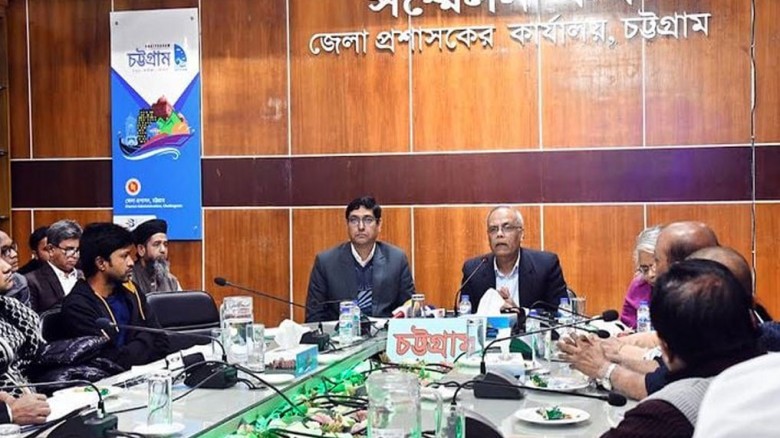 Photo: